Service Design • Nonprofit • Strategic Roadmap • Stakeholder Research • Inclusive Design
Client
Kick2Build
Role
UX Researcher & Strategist
Status
Phased Implementations
Deliverable
Structural Recommendations
Research Approach — Listening sessions led to a full stakeholder research initiative
The Challenge
Kick2Build is a youth sports nonprofit with a strong culture, growing participation, and a coaching staff invested in the kids. Leadership wanted feedback on their programs and held an end-of-year listening session to gather it. Some of the feedback pointed to questions a listening session couldn't fully answer, so the engagement expanded into a research initiative.
As participation grew, the informal structures that had carried the organization were starting to show strain.
Research Approach
Different roles inside Kick2Build relate to the organization differently. A coach's day-to-day is shaped by team logistics and player development; a parent's is shaped by communication, registration, and what their child's experience looks like week to week. Covering both, alongside administrative perspective, was necessary to see how the organization was actually functioning.
Competitive Analysis — 5 youth sports platforms
TeamSnap, LeagueApps, Spond, TeamApp, GameChanger were reviewed first to establish a baseline of what category-leading tools support and where they leave gaps. Across the five, feature sets concentrated on logistics: scheduling, payments, messaging, and administrative tools. Community features and accommodations for families with limited digital access were less developed.
Stakeholder interviews — 8 Across 3 roles
One administrator. Three coaches. One coach who also served as the informal family access contact, a function the organization relied on but had never structured. Three parents. The questions focused on how each role actually navigated the organization week to week, including the workarounds people had developed. Families described moving between Play Metrics, biweekly admin emails, WhatsApp for game-day and time-sensitive updates, spreadsheets, and in-person conversations to stay current.
The competitive review framed the category. The interviews showed what was uniquely happening inside the organization.
What the Research Uncovered
What Parents, coaches, and admins were experiencing
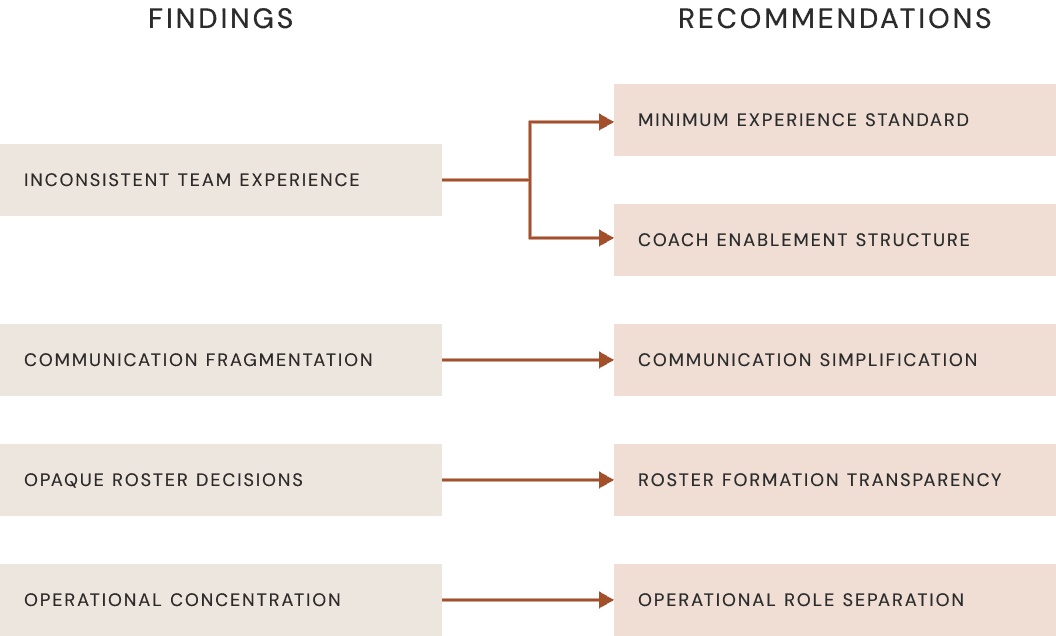
Inconsistent team experience
Coaching structures and behavior expectations varied team to team. Families described team assignment as feeling like luck of the draw, with their child's experience depending heavily on which coach they were placed with for the season.
Communication fragmentation
Information about practices, games, and registration moved across multiple channels, with no consistent expectation about which carried which kind of update. Registration workflows assumed digital fluency, which created friction for families who preferred face-to-face contact.
Opaque roster decisions
Parents weren't sure how teams were formed or what factors went into placement. Roster decisions that affected team size and consistency were difficult to interpret, and parents sometimes read them as misaligned with the organization's stated values around development and inclusion.
Operational concentration risk
A significant portion of day-to-day coordination ran through a single staff member. The organization was operating effectively, but the structure depended on that person's continued availability rather than on shared systems.
Across the four findings, the same pattern emerged: coordination, decisions, and information were running through people rather than through systems.
From Research to Service Design
The findings translated into five structural recommendations, now in phased implementation.

Structural recommendations
1
Minimum Experience Standard
Clear expectations across coaching responsibilities, behavior protocols, playing time philosophy, and escalation pathways. Gives families a consistent baseline for what to expect across teams.
2
Coach Enablement Structure
Intentional placement, preseason orientation, and ongoing mentorship and escalation channels. Supports coaches with the structure to deliver on the experience standard.
3
Communication System Simplification
A defined weekly source of truth, a real-time channel for time-sensitive updates, and guidance on which to trust for what kind of information. Built to streamline the methods families were already using.
4
Roster Formation Transparency
Published principles covering how teams are formed, what factors are considered, and when changes occur. Gives parents context for placement and roster changes.
5
Operational Role Separation
Designated responsibilities across coaching leadership, scheduling and operations, and family access support. Distributes coordination across roles rather than concentrating it in one.
Why This Matters
The engagement produced structural recommendations rather than a product, which matched the questions the listening session had opened. Those were conversations about how the organization operated, not about what tool could be added to it.
Working at the level of governance, communication, and role structure gave leadership a set of changes they could phase in and evaluate over time. Together, the five recommendations contribute to culture, clarity, and resilience as the organization scales.